
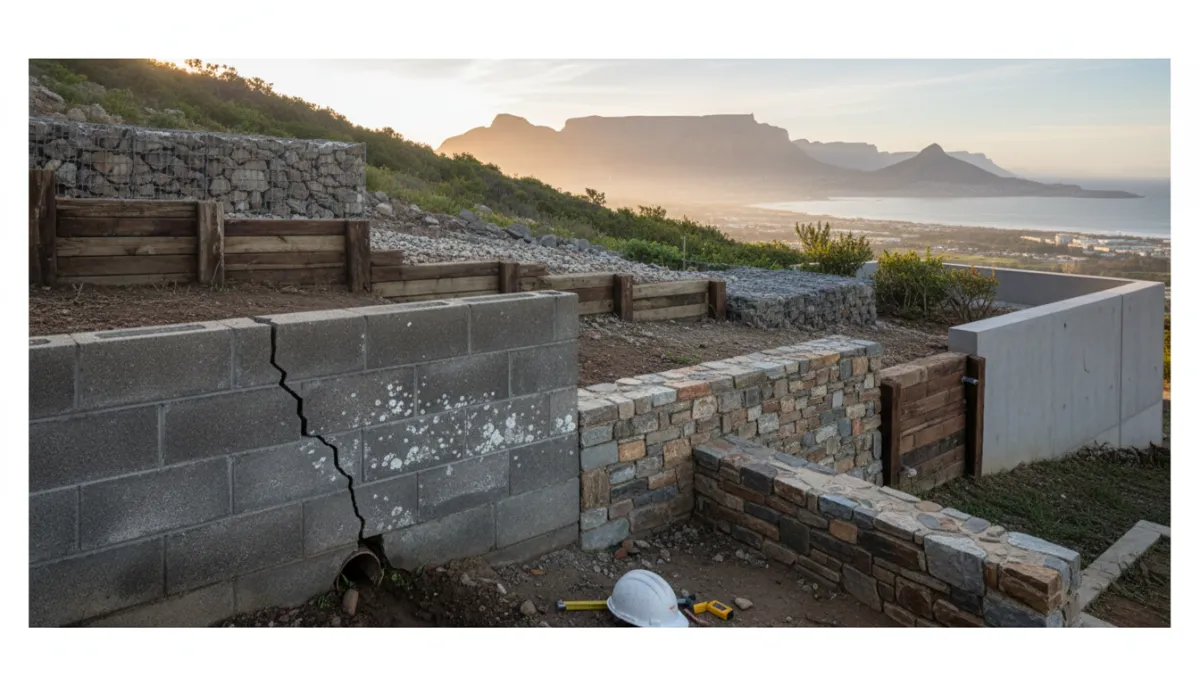
Retaining Wall Repair Costs & Signs in Cape Town
Retaining Walls, Structural Repairs, Cape Town
Retaining Wall Repair in Cape Town: Signs of Failure & What It Costs (2026)
Cape Town’s steep plots, clay-rich soils and intense winter rain make retaining walls work hard all year round. Identifying early warning signs – and budgeting realistically for repairs – is essential to protect your home, garden and neighbouring properties.
Early warning signs your retaining wall is in distress
Retaining walls rarely fail overnight. They usually give months – sometimes years – of subtle clues. Addressing these early is far cheaper than dealing with a collapsed wall after a Cape winter storm.
Leaning or tilting – even a slight forward lean suggests movement at the base or inadequate reinforcement. Use a straight edge or spirit level to check if the wall is truly vertical.
Bulging – localised bulges in the middle of the wall usually indicate pressure build-up from saturated soil or failed drainage behind the wall.
Horizontal and vertical cracking – horizontal cracks often point to structural overload, while stepped or vertical cracks may indicate settlement, poor foundations or thermal movement in masonry and concrete block walls.
Efflorescence – white, powdery deposits on brick, block or concrete show that water is moving through the wall, bringing salts to the surface. On its own it is cosmetic, but it often flags hidden moisture and drainage problems.
Drainage failure – blocked weepholes, no visible outlets, water seeping through joints or pooling behind the wall after rain are all signs that hydrostatic pressure is building up, the leading cause of retaining wall failure in wet climates such as Cape Town’s winter season.
Settlement – sinking sections, gaps opening at the top, or paving dropping near the wall indicate foundation movement or inadequate bearing capacity of the soil.
💡 Pre-winter tip: Carry out a visual inspection and clear all weepholes, surface channels and French drains before the first heavy Cape winter rains arrive.
Common Cape Town retaining wall types – and how they fail
Local properties use a mix of materials and structural systems, each with typical weak points:
Brick and mortar walls – popular for boundary terraces. They commonly suffer from stepped cracking, mortar erosion, efflorescence and bowing where foundations are shallow or drainage is poor.
Concrete block (including segmental block) walls – widely used for garden levels. Failures include joint cracking, block rotation, outward lean and loss of interlock where backfill is not compacted or reinforced correctly.
Natural stone walls – attractive on older and heritage properties. They tend to lose stones, open joints and bulge if the backing concrete or rubble core loses cohesion or if tree roots push through.
Gabion baskets – increasingly common along driveways and watercourses. Typical issues include corrosion of baskets, slump where foundations are not level, and wash-out of fine material behind the wall if filters and drainage are missing.
Timber sleeper walls – cost-effective for low garden terraces. In Cape Town’s coastal and damp conditions, sleepers can rot, tilt or heave, and anchors may corrode, leading to sudden localised failures.
Engineered reinforced concrete walls – used where higher loads, driveways or structures are retained. They are robust but can develop structural cracking, spalling and significant lean if reinforcement is inadequate or if drainage behind the wall is neglected.
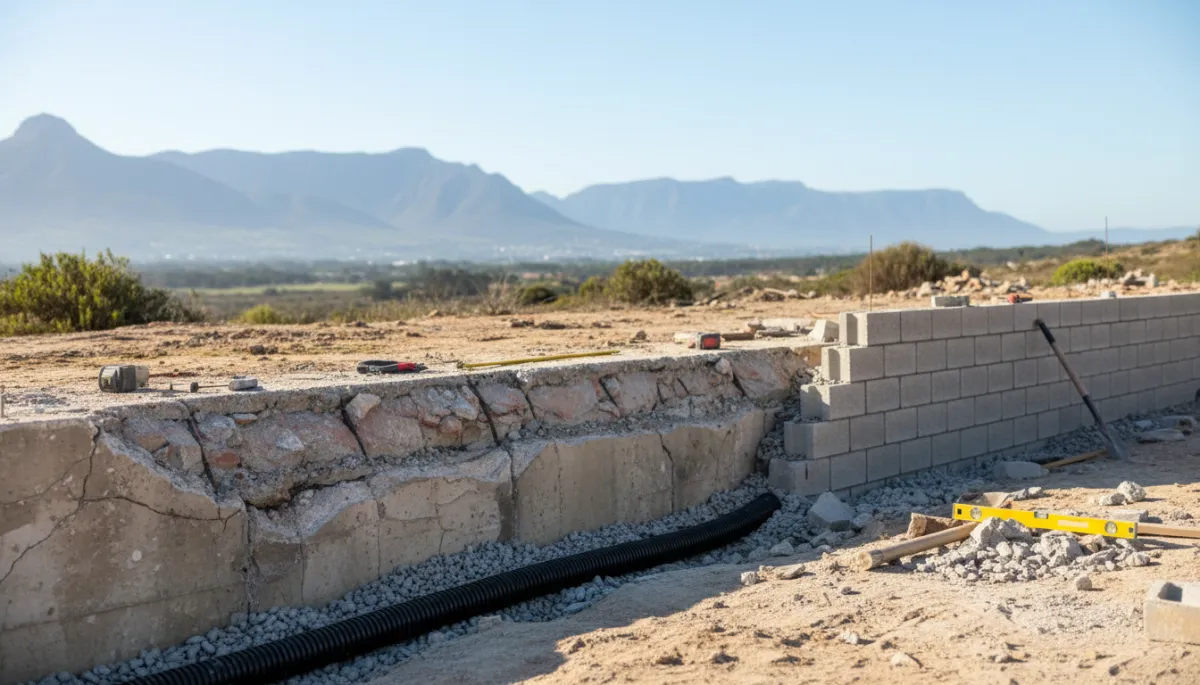
Correct drainage and foundations are critical to avoid repeating earlier retaining wall failures.
What retaining wall repairs cost in Cape Town in 2026
Repair costs vary with access, wall type, height and the extent of structural damage, but current Cape Town benchmarks provide a useful guide. New or full replacement retaining walls typically range from around R900 to R4,500 per m² of wall face, from simple timber or dry-stacked block through to reinforced concrete and engineered systems.
Drainage improvements – clearing weepholes and adding surface channels is relatively low cost. Installing new behind-wall drainage or French drains, including excavation and reinstatement, often falls in the R8,000–R25,000 range for a small to medium section, depending on depth and access, but can be higher on steep or constrained sites.
Crack repairs and local strengthening – repointing mortar joints, stitching masonry cracks and adding small braces are usually at the lower end of retaining wall work. On typical domestic walls, allowances of R8,000–R30,000 are common for localised repairs, in line with broader boundary and retaining wall repair ranges of R8,000–R60,000.
Partial rebuilds – where a short leaning or bulging section is rebuilt with proper foundations and drainage, owners might expect costs in the tens of thousands of rands. A modest 10 m² section rebuilt in block or gabions could easily reach R18,000–R45,000 once excavation, spoil removal and engineering sign-off are included.
Full replacement – for high or heavily loaded walls, especially engineered concrete or reinforced masonry, complete reconstruction often sits between R40,000 and R130,000+ per project, depending on height, length and structural complexity.
When you must involve a structural engineer
In Cape Town, any retaining wall over roughly 1.5 m high, or one supporting driveways, buildings or neighbouring properties, should be treated as a structural element. If such a wall shows noticeable leaning, extensive cracking, rapid movement after rain, or if there has already been a minor collapse, a registered structural engineer must be consulted for assessment, design of remedial works and, where required, municipal approvals.
Our company undertakes repairs to brick and mortar, concrete block, natural stone, gabion, timber sleeper and engineered concrete retaining walls across Cape Town. Where walls are high, complex or show significant movement, we coordinate the full process – from arranging the structural engineer’s inspection and design through to construction, drainage upgrades and final reinstatement – providing a single point of contact for owners.
A simple pre-winter inspection and drainage clearance can often prevent far more expensive structural repairs. If you notice early signs such as leaning, bulging, cracking, efflorescence or settlement, it is prudent to obtain a professional assessment and costed repair plan before the next Cape winter puts your retaining wall to the test.

Serving Atlantic Seaboard, CBD & surrounds
fixr.capetown • Whatsapp: 084 668 3307