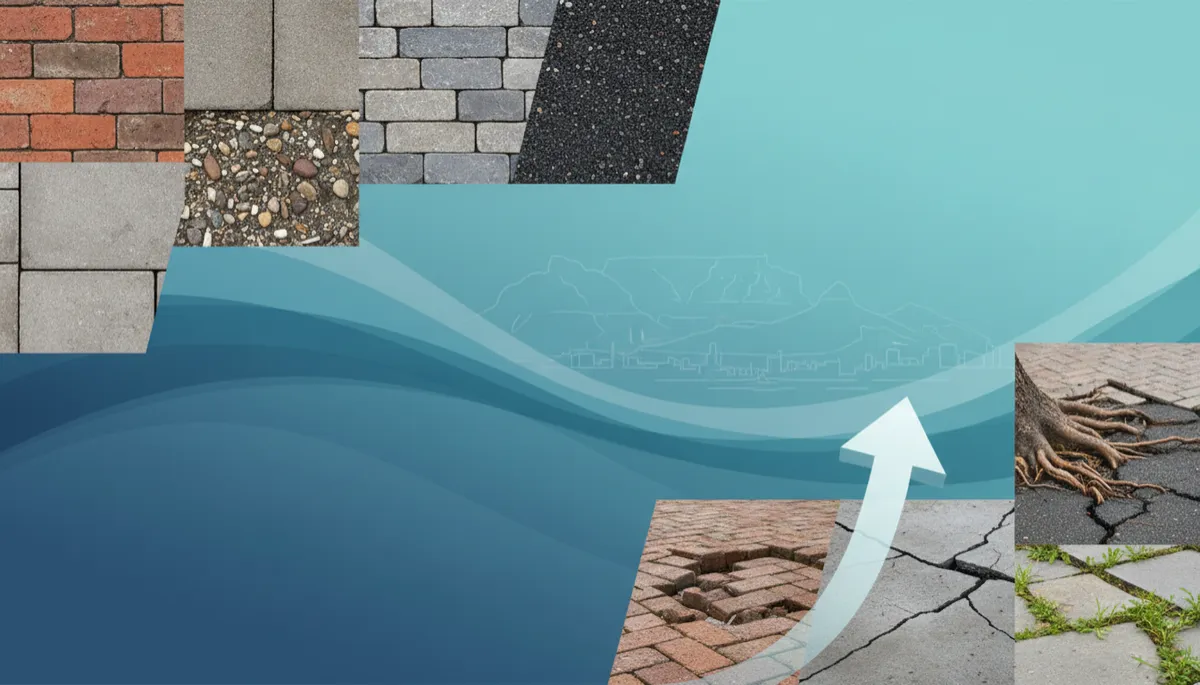
Paving & Driveway Costs in Cape Town 2026
Paving, Driveways, Home Improvement, Cape Town
Paving & Driveway Repair Cost in Cape Town (2026 Guide)
Planning paving repair or a new driveway in 2026 can feel daunting if you do not understand local materials, common faults, and realistic price ranges. This professional guide unpacks typical paving and driveway repair costs in Cape Town, how they are calculated, and what homeowners should watch for before accepting a quote.
1. Common Paving Types in Cape Town
Cape Town homeowners can choose from a range of paving materials, each with different performance characteristics and price points. Understanding these options is the first step in planning paving repair Cape Town or new paving installation Cape Town.
Brick and Concrete Interlocking Pavers
Interlocking concrete pavers (often called bevels or cobble pavers) are the workhorse of Cape Town driveways and walkways. They are designed to lock together, spreading vehicle loads effectively when laid on a properly compacted base. Installed prices for standard interlock or bevel bricks generally range from around R380 – R520 per m² for budget options, moving up to about R650 – R950 per m² for thicker driveway-grade pavers with full base preparation and edging included (Green Fix).
Clay brick pavers offer a similar modular format but with a richer, more traditional appearance. They retain colour throughout the brick and typically cost between R550 – R750 per m² for standard residential work, and up to around R1 050 – R1 450 per m² on premium driveway projects in 2026 (2Green, Green Fix).
Natural Cobblestone and Granite Setts
Natural cobblestone, often granite, is a premium option used for feature driveways, courtyards and entrance aprons. These blocks are extremely durable and suit Cape Town’s coastal conditions well, but they are labour-intensive to install. Typical installed prices are in the region of R1 200 – R1 700 per m² in 2026 (Green Fix).
Exposed Aggregate Concrete and Paving Slabs
Exposed aggregate concrete combines a cast concrete slab with decorative stone exposed on the surface. It is increasingly used for modern driveways and entrance areas. Driveway-grade exposed aggregate or stamped concrete in Cape Town typically falls between R850 – R1 400 per m² installed (Green Fix).
Concrete paving slabs and flagstones (for example 450×450 mm or 600×600 mm) are common for patios and walkways and are sometimes used on light-use driveways. Budget slabs start from about R420 – R580 per m² installed for standard concrete flagstones, while large-format or textured slabs can reach R650 – R900 per m² or more (Green Fix).
Tar / Asphalt Driveways
Tar or asphalt remains a cost-effective option for long or sloped driveways. A hot asphalt overlay on an existing sound base in Cape Town usually costs around R270 – R420 per m², while a brand-new tar driveway including excavation and sub-base preparation typically ranges from R480 – R750 per m² (NGST Civils).
2. Common Paving Faults in Cape Town and Their Causes
Many driveway repair Cape Town projects arise from predictable faults that can often be traced back to inadequate base preparation, drainage, or tree root management. Recognising these issues helps you judge whether a contractor’s proposed repair method and price are reasonable.
Sunken or Uneven Paving
Sunken patches, “birdbaths” and uneven levels are among the most common complaints. Causes include:
Insufficient compaction of the sub-base or bedding sand during original installation.
Localised wash-out of bedding material due to poor drainage or leaking pipes.
Long-term movement of Cape Town’s reactive clay soils, especially in areas with seasonal moisture changes.
Cracked Pavers and Surface Spalling
Individual bricks, concrete pavers or slabs may crack due to point loads from heavy vehicles, inadequate thickness (for example using 50 mm pavers on a driveway instead of 60 mm), or hard spots in the sub-base. On exposed aggregate concrete, surface cracks can appear where joints were poorly cut or where the slab is restrained by building foundations or kerbs.
Root Heave from Trees (Especially Oaks)
Cape Town’s older suburbs are well-known for mature oak trees and other large species planted along verges and driveways. As roots thicken, they lift paving, creating ridges and trip hazards. Without a proper root barrier, even newly installed paving can distort within a few years, particularly on narrow driveways where roots are concentrated under the wheel tracks.
Weed Growth Through Joints
Weeds rarely grow from below the paving. Instead, wind-blown seeds settle in jointing sand, especially where the joints have been washed out by rain or high-pressure cleaning. In Cape Town’s winter rainfall climate, damp shaded driveways are particularly prone to moss, algae and weed growth if not maintained with re-sanding and occasional herbicide treatment.
Edge Restraint Failure
Paving relies on solid edge restraints (concrete kerbs or soldier courses bedded in concrete) to prevent lateral creep. When these edges crack, break away or were never properly installed, the paved area slowly spreads, creating gaps and misalignment. This is a frequent cause of failure on older driveways where edging was seen as an optional extra rather than a structural necessity.
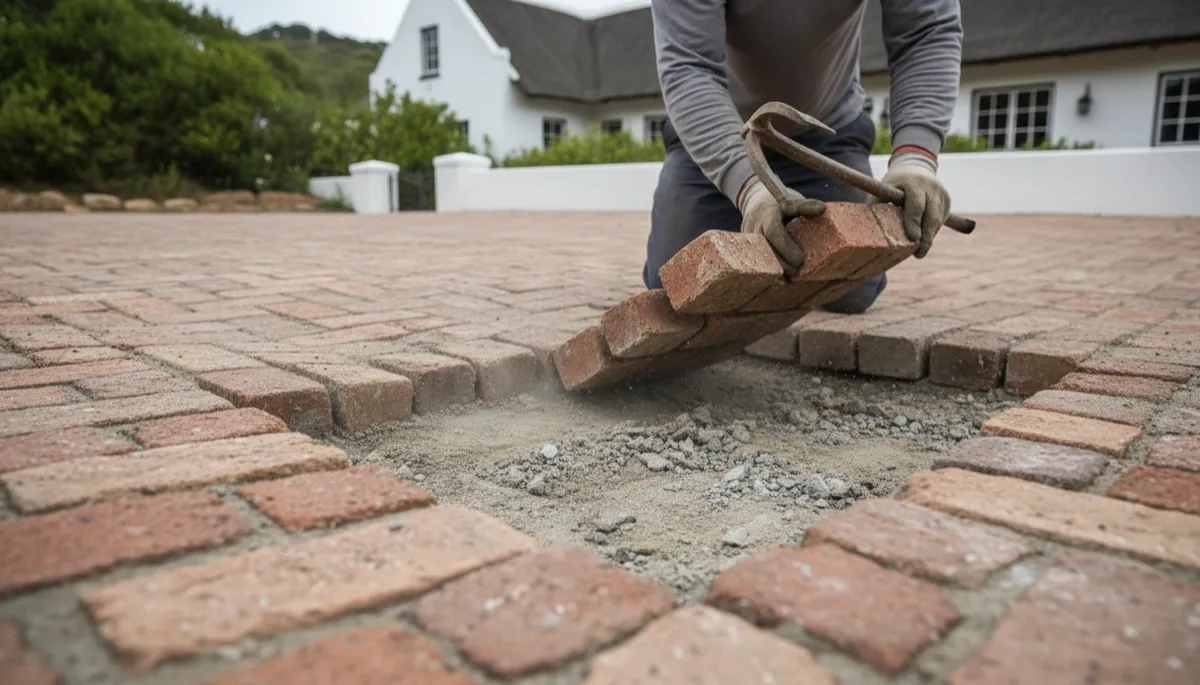
Most sunken paving repairs start by lifting bricks and rebuilding the compacted base.
3. Paving Repair Costs in Cape Town (2026)
Repairing rather than replacing paving can save 40–60% if the existing materials are still in good condition (Green Fix). Below is an overview of typical costs for common repair types in 2026.
Localised Lift-and-Relay Repairs
Lift-and-relay involves lifting the affected bricks or pavers, reworking the base and bedding sand, then re-laying the existing units. In Cape Town, professional contractors typically charge around R380 – R650 per m² for this service, depending on access, paving type and depth of base required (Green Fix).
For a small sunken patch of 2–6 m², you can expect a total repair bill in the region of R3 500 – R12 000, including call-out, labour and materials. National pricing guides list lift-and-relay at R250 – R450 per m², but Cape Town’s 2026 rates tend to sit at the higher end due to labour and material costs (Fonster).
Individual Paver or Slab Replacement
Replacing a few cracked bricks or slabs is usually charged on a call-out basis rather than per square metre. National guides suggest R500 – R1 500 per call-out for small replacement jobs (Fonster). In Cape Town, this often includes up to a square metre or so of work, plus any new pavers required if you do not have spares on site.
Root Barrier Installation and Root-Heave Repairs
Where oak or other large tree roots have lifted paving, a proper repair involves lifting the affected area, carefully trimming or bridging roots (subject to arborist advice), installing a root barrier membrane, rebuilding the base and re-laying the paving. Because this work is labour-intensive and often in confined areas, costs can exceed standard lift-and-relay rates. As a planning figure, allow R450 – R750 per m² for root-heave repairs, plus additional fees if a tree specialist must be involved.
Exposed Aggregate Crack Repair
Cracks in exposed aggregate or stamped concrete driveways are more challenging to disguise than in modular paving. Fine shrinkage or hairline cracks may be treated with flexible sealants and re-sealing, while structural cracks sometimes require partial slab replacement. Minor crack repair and resealing typically falls into the R150 – R250 per m² “minor repairs” bracket, while more extensive patching or overlays can cost R300 – R500 per m² (World of Paving).
Re-sanding, Weed Treatment and General Maintenance
Routine maintenance includes high-pressure cleaning, joint re-sanding, weed control and, in some cases, sealing. Typical 2026 Cape Town rates are:
Cleaning only: R100 – R200 per m².
Sealing only: R200 – R400 per m², depending on product and number of coats.
Comprehensive maintenance (cleaning, re-sanding, weed treatment and sealing): typically R300 – R500 per m² (World of Paving).
For homeowners comparing quotes, it is important to confirm whether jointing sand, herbicide treatment and post-clean-up are included, as these significantly affect the long-term performance and appearance of your paving.
4. New Paving Installation Costs by Material (2026)
If repairs are extensive or your existing driveway is reaching the end of its life, full replacement or new paving installation Cape Town may make more financial sense. The following ranges include typical base preparation, labour, edging and clean-up unless stated otherwise (Green Fix, Green Fix).
Material Type | Typical Installed Cost (R/m²) | Notes (2026, Cape Town) |
|---|---|---|
Bevel / Interlock concrete pavers | R380 – R520 (budget); R650 – R950 (driveway-grade) | Most common for driveways and paths; thickness usually 60 mm for vehicles. |
Clay brick pavers | R550 – R750 (general); R1 050 – R1 450 (premium driveways) | Warm, traditional look; higher labour cost but excellent longevity. |
Concrete slabs / flagstones | R420 – R580 (standard); R650 – R900 (large-format / textured) | Popular for patios and paths; selected slabs can be used on light-use driveways. |
Cobblestone / granite setts | R1 200 – R1 700 | High-end, long-lasting option; ideal for feature driveways and entrances. |
Exposed aggregate / stamped concrete | R850 – R1 400 | Modern look; requires good joint layout and sealing to minimise cracking. |
Tar / asphalt (new driveway) | R480 – R750 | Cost-effective for long or steep driveways; appearance more utilitarian. |
5. Typical Driveway Costs: Single vs Double
While every property is different, it is helpful to work with approximate sizes when budgeting for driveway repair Cape Town or full replacement. A compact single driveway is often 18–25 m², while a standard double driveway ranges from 45–60 m². Using 2026 per-square-metre rates, we can outline realistic ballpark figures (Okhantu, Green Fix).
Single Driveway (±20 m²) – Example Budgets
Budget bevel brick paving at ±R500 per m²: ±R10 000.
Standard interlock driveway at ±R800 per m²: ±R16 000.
Clay brick driveway at ±R1 200 per m²: ±R24 000.
Tar driveway with full base at ±R600 per m²: ±R12 000.
Double Driveway (45–60 m²) – Example Budgets
Bevel brick at R380 – R520 per m²: approximately R23 000 – R31 000 for 60 m² (Green Fix).
Clay brick at R550 – R750 per m²: approximately R33 000 – R45 000 for 60 m².
Premium interlock or decorative finishes at R900 – R1 250 per m²: R40 500 – R75 000 for 45–60 m² (Green Fix).
Tar driveway with full base at R480 – R750 per m²: R21 600 – R45 000 for 45–60 m².
Industry cost guides indicate that most complete driveway projects in Cape Town fall between R20 000 and R80 000, with high-end or complex sloped sites exceeding R90 000 in 2026 (Okhantu, Green Fix).
6. Cape Town–Specific Site Considerations
Two driveways with the same area can differ in cost by 30% or more depending on local ground conditions, access and detailing. In Cape Town, several recurring factors influence both price and long-term performance of paving repairs and installations.
Clay Soil Movement and Ground Conditions
Many inland suburbs sit on reactive clay soils that shrink in summer and swell in winter. This seasonal movement can cause differential settlement under driveways, leading to sunken or heaved areas. Professional contractors often specify thicker sub-bases, geotextile membranes or stabilised sub-layers in these areas, increasing costs but significantly improving durability. When comparing quotes, confirm the proposed sub-base thickness and compaction standards, especially if your property has a history of movement or cracking in other hard surfaces.
Oak Tree Roots and Mature Vegetation
In older areas such as the Southern Suburbs, large oaks and plane trees are a defining feature – and a frequent cause of root heave. When planning paving repair or replacement close to mature trees, factor in:
Possible involvement of an arborist for root pruning advice and permissions.
Installation of vertical root barriers or reinforced bases to limit future movement.
More frequent maintenance where complete root exclusion is not feasible.
These measures add upfront cost but reduce the likelihood of repeated, disruptive repairs every few years.
Slope, Access and Drainage Design
Cape Town’s topography means many homes sit on steep or irregular plots. Steep driveways require more excavation, thicker bases and careful detailing (such as raked patterns or rougher surfaces) to prevent slipping. Contractors may also need to bring in materials manually where machinery access is limited, raising labour costs. Industry guidance suggests allowing 20–35% more for difficult, sloped or tight-access sites (Green Fix).
Drainage is another critical aspect. Cape Town’s winter storms can quickly overwhelm poorly drained driveways, leading to erosion of bedding sand and premature failure. When reviewing quotes, check whether the price includes:
Surface falls directing water away from buildings and towards safe discharge points.
Channel drains, soakaways or other stormwater solutions where necessary (often R3 500 – R12 000 per installation (Green Fix)).
7. Deciding Between Repair and Full Replacement
As a rule of thumb, lift-and-relay or localised repairs are cost-effective when:
The majority of pavers are intact and visually acceptable.
Problems are limited to specific areas (for example, a sunken patch or local root heave).
You are satisfied with the existing layout and drainage performance once corrected.
When widespread settlement, repeated cracking, or poor drainage affects the entire driveway, full replacement often delivers better long-term value. In 2026, typical lift-and-relay repair costs of R380 – R650 per m² compare with R650 – R1 600 per m² for complete replacement with new materials (Green Fix). For a 55 m² double driveway, that translates to roughly R21 000 – R36 000 for repair versus well over R57 000 for a new, upgraded surface.
8. How to Approach Quotes for Paving Repair Cape Town
To make informed decisions and avoid unexpected extras, request written quotes that clearly separate:
Area in square metres and exact paving type (including thickness and manufacturer where possible).
Sub-base specification (material type, depth, and compaction standard).
Edge restraints, drainage components, root barriers and any retaining structures.
Rubble removal, skip hire, access challenges and VAT.
📌 Key Takeaway: The lowest quote is not always the best value. In Cape Town’s climate and soil conditions, investing in proper base preparation, drainage and root management will almost always cost less over the life of your driveway than repeated patch repairs.
Final Thoughts
Whether you are dealing with sunken paving, cracked bricks, root heave or simply an ageing surface, understanding realistic 2026 costs for paving repair Cape Town and new driveway repair Cape Town projects allows you to plan with confidence. Use the ranges in this guide as a benchmark, then obtain at least two or three detailed, site-specific quotes before proceeding. With the right contractor and specification, quality paving should provide decades of safe, attractive service in Cape Town’s demanding conditions.
